
How Pests Threaten Global Food Security and Agriculture
2/6/20268 min read
Introduction: The Global Challenge of Insect Pests in Agriculture
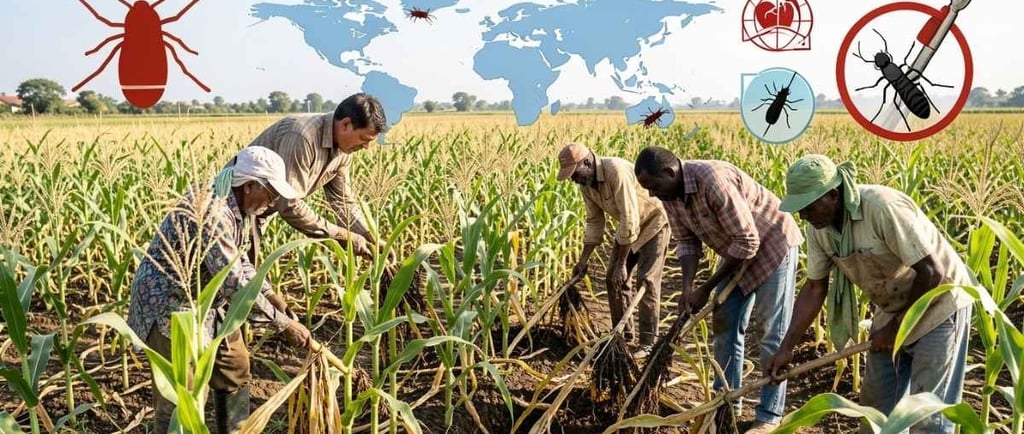
Insect pests present a substantial challenge to agricultural productivity and food security globally. With the world’s population continuously increasing, the pressure on agricultural systems to provide sufficient food resources is immense. Insect pests, which encompass a wide range of species, including caterpillars, aphids, and beetles, are responsible for significant crop damage each year. It is estimated that such pests contribute to the loss of approximately 20-30% of global crop yields, leading to dire economic consequences and food scarcity issues.
The impact of insect pests extends beyond merely affecting crop yields; these pests can disrupt entire ecosystems and agricultural practices. Farmers are often compelled to resort to extensive chemical pesticide applications, which can result in harmful environmental effects and a decrease in biodiversity. Furthermore, the reliance on chemical interventions may create resistance among pest populations, leading to the emergence of harder-to-control species. This cycle creates a pressing need for sustainable pest management strategies within agricultural production systems.
Globally, regions heavily reliant on agriculture are hit the hardest by invasive insect pests, which not only threaten food crops but also the livelihoods of countless farmers. As these pests continue to adapt and spread across borders, addressing the consequences of their presence has become increasingly complex. The challenge is compounded by factors such as climate change and global trade, which facilitate the movement of pests into new environments, often without adequate control measures in place.
Recognizing the intricacies of pest dynamics is essential for both policymakers and agricultural stakeholders. Innovative solutions—ranging from integrated pest management to biological control methods—will be vital in confronting the challenges insect pests pose to global agriculture. The exploration of such solutions will be discussed in subsequent sections, focusing on mitigating the threats to ensure a secure and sustainable food supply for future generations.
Types of Insect Pests: A Closer Look at Locusts, Beetles, and More
Insect pests pose a significant threat to global agriculture, with locusts and beetles among the most damaging varieties. Understanding their biology and habits is crucial in developing effective management strategies.
Locusts, particularly the species known as the desert locust (Schistocerca gregaria), are notorious for their swarming behavior. They can form large migratory groups that can devastate crops across vast areas. This species undergoes a transformation from solitary to gregarious phases, changing their behavior and density under certain environmental conditions, particularly after rainfall when food becomes abundant. Locust swarms are capable of consuming crops that could feed millions, thus leading to food insecurity.
On the other hand, beetles are diverse and numerous, with some, such as the Colorado potato beetle (Leptinotarsa decemlineata), specifically targeting crops like potatoes, tomatoes, and eggplants. These pests possess remarkable adaptations, such as a high reproductive capacity and resistance to pesticides. The life cycle of beetles typically involves laying eggs on the host plant, where larvae emerge and begin to feed on the foliage, leading to significant crop damage if not managed properly.
Another prominent beetle is the Asian corn borer (Ostrinia furnacalis), which primarily affects maize. Its larvae bore into the corn stalks and ears, causing weakening of the plant and reduced yield potential. Effective pest management strategies must be employed to mitigate the impact of both locusts and beetles. This can include integrated pest management (IPM) techniques, which emphasize biological control, habitat management, and resistant crop varieties.
Understanding the specific threats posed by locusts and beetles is essential for developing robust agricultural practices that protect food security globally.
The Extent of Crop Damage: Statistics and Global Impact
Insect pests are a significant and escalating threat to global agriculture, inflicting extensive damage on crops across the world. According to the Food and Agriculture Organization (FAO), it is estimated that insect pests destroy about 20% to 30% of global crop production annually. This staggering statistic highlights the persistent struggle that farmers face in safeguarding their crops from these elusive and adaptive pests.
In the context of economic impact, the financial losses due to insect pests can reach upwards of $470 billion per year worldwide. This economic strain affects not only the agricultural sector but also the broader economy, especially in developing nations where agriculture is often the backbone of the local economy. In many regions, the reliance on staple crops like rice, maize, and wheat makes these losses particularly alarming, exacerbating issues such as food scarcity and inflation.
The implications of crop damage extend beyond economic losses; they also pose significant challenges to food security. As the world's population continues to grow, expected to reach nearly 10 billion by 2050, the demand for food will only increase. Insect pests may hinder the ability of the agricultural sector to meet this demand, leading to increased prices and decreased access to essential food items.
This situation is even more severe in developing countries, where resource constraints limit farmers' ability to combat pest outbreaks effectively. Smallholder farmers often lack access to modern pest control technologies and practices, making them particularly vulnerable to the effects of crop damage. This vulnerability threatens not only their livelihoods but also the overall food supply in regions that often struggle with malnutrition and hunger.
Addressing the threats posed by insect pests is essential for the sustainability of global agriculture. As new pests emerge and existing ones adapt to changing climates, comprehensive strategies that encompass timely interventions, pest management practices, and support for farmers are critical to mitigate these impacts.
Storage Losses: How Insect Infestations Compromise Crop Yields
Insect pests pose a significant threat to agriculture, particularly concerning stored grain and produce. Post-harvest losses caused by insect infestations can lead to considerable reductions in both the quality and quantity of crops, directly impacting food security and economic stability. The presence of pests in storage facilities can compromise nutritional value, cause physical damage, and promote the growth of pathogens, leading to spoilage and waste.
One of the primary culprits of storage losses is the ability of certain insects to reproduce rapidly in a confined environment, thereby overwhelming existing pest management strategies. Insect pests such as the rice weevil, maize weevil, and Indian meal moth can infiltrate storage units, resulting in significant infestations. Studies indicate that these pests can lead to a loss of up to 20% of stored grains annually, depending on the region and the type of crop involved. This loss not only affects farmers' income but also exacerbates food scarcity issues in various parts of the world.
To mitigate these post-harvest losses, effective storage solutions and integrated pest management practices are essential. Adequate storage conditions, such as maintaining low humidity and temperature, can help deter infestations. Additionally, the implementation of physical barriers, regular monitoring, and the use of biological control agents are vital components of a comprehensive pest management plan. Some farmers also adopt traditional methods, such as the use of diatomaceous earth or botanical insecticides, which have shown promise in controlling pest populations without relying solely on synthetic chemicals.
Addressing the challenge posed by insect pests in storage requires concerted efforts from farmers, researchers, and policymakers. By investing in appropriate technologies and pest management practices, it is possible to significantly reduce storage losses and ensure a stable food supply, ultimately contributing to the resilience of global agriculture.
Supply Chain Disruption: Linking Pest Infestation to Food Insecurity
The presence of insect pests has increasingly emerged as a significant threat to the agricultural supply chain, contributing to food insecurity across various regions. Pest infestations can occur at any stage of production, from the initial planting of crops to harvesting and post-harvest storage. Each level of the supply chain can encounter unique challenges posed by these pests, ultimately affecting the availability and price of food.
When infestations occur in the field, crops may suffer significant damage, leading to reduced yields. This decline results in lower quantities of food available for consumers. Additionally, pests that invade storage facilities can ruin large stocks of harvests, exacerbating shortages and wastage. Such damage forces farmers and suppliers to increase prices to offset their losses, making it difficult for low-income communities to access affordable food. The economic impact of pest-related losses can ripple through the entire supply chain, leading to heightened food prices and contributing to nutritional deficits.
The issue of food security becomes especially pressing in areas that rely heavily on local agriculture. These regions often lack the infrastructure and resources required to effectively manage pest populations, making them particularly vulnerable to the ramifications of infestations. The interconnected nature of the global food supply chain means that pest outbreaks in one geographical region can have far-reaching consequences, including rising prices and shortages in markets half a world away.
Addressing the implications of pest infestations requires coordinated efforts to enhance pest management strategies, promote sustainable agricultural practices, and invest in protective technologies. Without these interventions, the threat posed by insect pests will persist, jeopardizing not only crop yields but also global food security.
Integrated Pest Management: Strategies for Combating Insect Threats
Integrated Pest Management (IPM) is a holistic approach that combines various strategies to effectively manage insect pests while minimizing their impact on agriculture. It recognizes the importance of ecological balance and aims to provide sustainable solutions to pest challenges. The implementation of IPM encompasses several strategies that can be tailored to specific agricultural contexts, thereby addressing both immediate pest threats and long-term agricultural health.
One key component of IPM is the utilization of technology. Advances in pest detection technologies, such as drones and remote sensing, allow farmers to monitor and assess pest populations with greater precision. This data-driven approach not only optimizes pest management efforts but also assists in making informed decisions regarding when and how to apply control measures. Additionally, precision agriculture tools can help in tailoring interventions based on the specific needs of different areas within a farm, reducing unnecessary pesticide use.
Biological control is another critical strategy within IPM. This entails the introduction of natural enemies or beneficial organisms to suppress pest populations. For example, releasing ladybugs to control aphid outbreaks can be an effective way to manage pest issues without resorting to chemical controls. Furthermore, fostering biodiversity through intercropping and crop rotation can naturally deter pests by disrupting their life cycles.
Community education and engagement play a vital role in the success of IPM programs. Educating farmers about pest identification, life cycles, and management practices equips them with the knowledge to recognize pest threats and respond appropriately. Community engagement initiatives can also encourage collaboration among farmers, enabling them to share best practices and resources, thereby boosting the overall efficacy of pest management strategies.
By integrating technology, biological control measures, and community education, IPM provides a comprehensive framework for addressing insect pests in agriculture. These strategies collectively enhance the resilience of agricultural systems, ensuring that farmers can sustainably manage pests while preserving their crops and the environment.
Conclusion: The Path Forward in Sustainable Agriculture
In light of the significant challenges posed by insect pests on global agriculture, it is imperative to recognize the need for a cohesive strategy that involves ongoing research, innovative policy development, and the widespread implementation of sustainable agricultural practices. The adverse effects of pest infestations not only threaten crop yields but also impact food security, economic stability, and broader environmental ecosystems.
To combat these challenges effectively, it is essential to enhance our understanding of pest dynamics and their interactions with agricultural systems. Research should prioritize integrated pest management (IPM) strategies that employ a combination of biological, cultural, physical, and chemical control methods. Such approaches can minimize the reliance on chemical pesticides, which can have detrimental effects on both human health and the environment.
Furthermore, policy development should support farmers in adopting sustainable practices that prioritize ecological balance and long-term productivity over short-term gains. This includes providing resources and incentives that encourage research into alternative pest management strategies and fostering collaboration between agricultural stakeholders, researchers, and government entities. Education and outreach programs are crucial for equipping farmers with the knowledge and tools necessary to implement sustainable practices effectively.
Finally, promoting biodiversity through agroecological methods can enhance the resilience of agricultural systems to pest pressures. By maintaining diverse cropping systems and encouraging natural predators of pests, farmers can help mitigate the impact of pest outbreaks. Adopting these holistic approaches is vital for ensuring food security, protecting livelihoods, and sustaining the environment.
In summary, the path forward in addressing the challenges posed by insect pests in agriculture lies in collaborative efforts to champion research, policy reform, and the adoption of sustainable practices. By embracing these strategies, the agricultural sector can work towards a more sustainable and resilient future.
Address:
264/5, Kamal Soroni Road, Mirpur, Dhaka-1216
Contact
Your Quaries on pest control askings
pestexterminatorbd@gmail.com
+8801642008383 +8801988300003, 01723057746
© 2025. All rights reserved. to Urban Pest Control Pvt. Ltd. this site is powered by Our Own IT Team