
Water Purifier vs Boiled Water – Which Is Safer to Drink?
3/7/20267 min read
Introduction to Water Purification Methods
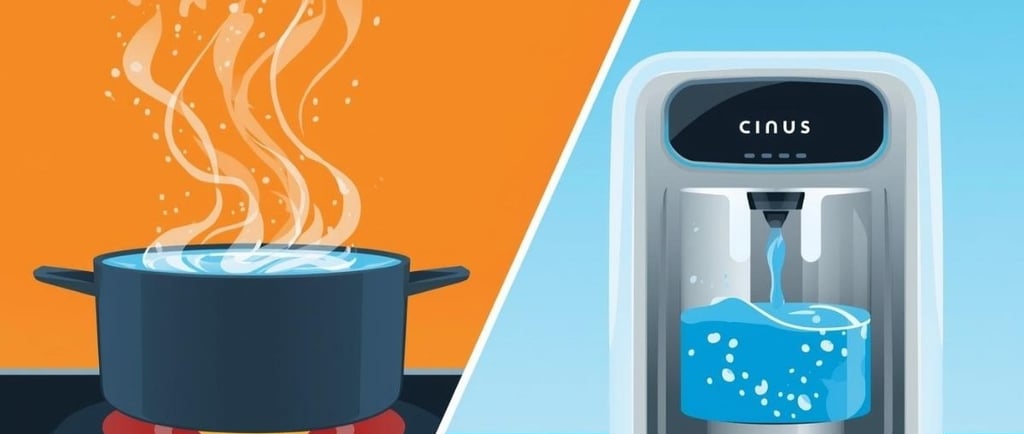
Access to clean and safe drinking water is crucial for maintaining overall health and safety. Two primary methods for purifying water are boiling and using water purifiers, each offering distinct advantages and considerations. Understanding these methods is essential for choosing the most suitable option based on individual needs and local water quality.
Boiling water is a traditional method that effectively eliminates a wide range of pathogens, including bacteria, viruses, and parasites. The process involves bringing water to a rolling boil for a minimum of one minute, which is sufficient to kill most microorganisms. This method is highly effective and does not require any special equipment, making it accessible in virtually any environment. However, boiling does not remove chemical contaminants or heavy metals, which may still pose risks if present in the water supply. Furthermore, boiling can alter the taste of water and does not provide a continuous supply of purified water unless significant quantities are prepped.
On the other hand, water purifiers utilize various filtration technologies to enhance water quality. These devices range from simple carbon filters that remove chlorine and improve taste to complex reverse osmosis systems that can eliminate dissolved solids, heavy metals, and other harmful substances. Water purifiers offer the advantage of convenience, delivering a steady supply of clean water with minimal effort. However, their effectiveness can vary based on the type of purifier used, ongoing maintenance requirements, and the quality of the source water. Additionally, some purifiers may remove essential minerals that can be beneficial to health.
Both boiling and water purifiers play a critical role in ensuring the safety and quality of drinking water. As water contamination remains a significant public health concern, understanding these purification methods allows consumers to make informed decisions to protect themselves and their families from harmful substances.
Bacteria Removal: Boiling vs. Filtration
When it comes to ensuring the safety of drinking water, two widely used methods for bacteria removal are boiling water and using water purifiers equipped with advanced filtration technologies. Each method has distinct mechanisms for eliminating harmful microorganisms from water supply.
Boiling water is a straightforward method that has been practiced for centuries. The science behind this process lies in exposing water to high temperatures, specifically above 100 degrees Celsius. This temperature is effective in killing a majority of bacteria, viruses, and parasites that can cause waterborne diseases. It is widely recommended that water should be boiled for at least one minute; however, in higher altitudes, a longer boiling time is advisable due to the lower boiling point of water. While boiling efficiently neutralizes biological threats in water, it does not remove physical contaminants such as dirt, minerals, or chemical pollutants.
On the other hand, water purifiers employ various filtration technologies tailored to target specific contaminants, including bacteria. Activated carbon filters are common in these systems and work by adsorption, capturing microbial contaminants as water flows through the filter media. Reverse osmosis is another advanced filtration method that utilizes a semi-permeable membrane to separate impurities, including bacteria, from water at a molecular level. This technology is particularly effective in providing purified water free from a wide range of contaminants.
While boiling is a reliable option for immediate bacterial eradication, it may not address all pollutants present in the water. In contrast, water purifiers, depending on their design and filtration capabilities, can provide a more comprehensive solution for achieving both biological and chemical purity. Therefore, the decision between boiling and using a water purifier should take into account the quality of the source water and the specific contaminants that need to be addressed.
Heavy Metal Filtration: Assessing Both Methods
Heavy metals, including lead, mercury, arsenic, and cadmium, are commonly found in water sources, often due to industrial discharges, agricultural runoff, and aging infrastructure. The presence of these contaminants in drinking water poses significant health risks, including neurological damage, developmental issues in children, and an increased risk of chronic diseases. Therefore, addressing heavy metal contamination is critical for ensuring safe drinking water.
When it comes to water purification, two prevalent methods are boiling and filtration, each exhibiting distinct efficacy in removing heavy metals from water. Boiling is a widely adopted method, often recommended for killing pathogens. However, it is essential to understand that boiling does not eliminate chemical contaminants like heavy metals. Instead, it can actually concentrate these harmful substances, as the volume of water decreases while the contaminants remain in the solution.
On the other hand, water purifiers equipped with appropriate filtration systems, such as activated carbon filters, reverse osmosis, and ion exchange units, are specifically designed to target heavy metals. For instance, reverse osmosis systems can effectively remove a broad spectrum of contaminants, including lead and arsenic, by forcing water through a semipermeable membrane. Filtration methods not only improve water quality by removing heavy metals but also enhance taste and odor, making the water more palatable.
In conclusion, while boiling may be an effective method for eliminating biological pathogens, it falls short in addressing the issue of heavy metal contamination. Water purification through advanced filtration technologies is a superior approach to remove these harmful substances, ensuring the safety and healthiness of drinking water against the backdrop of ongoing environmental challenges.
Impact on Minerals: The Good and the Bad
Water, a vital component for human health, contains various minerals that contribute to its overall quality. Among these, calcium and magnesium are often highlighted as essential for human nutrition. When it comes to the processes of boiling water and utilizing water purifier filtration, their effects on mineral content can be quite distinct.
Boiling water is a commonly employed method for ensuring bacterial safety. However, this process does not negatively impact the mineral composition of water significantly. The heat from boiling primarily serves to eliminate pathogens and does not actually remove minerals. Thus, beneficial minerals like calcium and magnesium remain intact, which is favorable for maintaining the nutritional quality of drinking water. For individuals concerned about their mineral intake, boiling can be a suitable option.
On the other hand, water purification systems, particularly those employing reverse osmosis (RO) technology, tend to have a more pronounced effect on mineral content. RO filters work by pushing water through a membrane that removes a vast array of impurities, including essential minerals. This can result in water that is low in beneficial substances, potentially leading to deficiencies if relied upon exclusively. While some filtration systems strive to achieve better taste and clarity, they may inadvertently strip away minerals that contribute to the overall health benefits of water.
Additionally, certain filter types, like activated carbon filters, primarily target chemicals and contaminants without significantly altering mineral levels. This makes them a preferable choice for individuals who wish to retain mineral content while enhancing water safety and taste. Ultimately, the impact on minerals in water—whether through boiling or filtration—is crucial for health and could influence consumer choices based on dietary needs and preferences.
Cost and Accessibility: Evaluating Practicality
When it comes to choosing between boiling water and utilizing water filtration systems, cost and accessibility are paramount factors influencing consumer decisions. Boiling water is a method that has been used for centuries and is generally regarded as economical. The primary cost associated with this approach is the energy source required for heating the water, whether it is gas, electricity, or even wood. For households that already have access to these energy sources, the ongoing costs may be minimal. However, in regions where energy prices are high or electricity is unreliable, boiling may become increasingly impractical. Such factors can complicate the cost-effectiveness of boiling water for purification.
On the other hand, water purifiers come with their own set of financial implications. The initial investment can vary widely depending on the type and brand of the water purification system. While some high-quality filter systems can provide long-term savings and enhanced water quality, the upfront costs may be a barrier for certain consumers. Additionally, maintenance costs, such as filter replacements and repairs, should be factored into the overall cost of ownership. In areas where water quality issues are prevalent, investing in a reliable water purifier might prove to be a worthwhile expenditure.
Accessibility is another critical consideration. In some regions, particularly in developing countries, access to clean water can be limited. While boiling water is accessible to many, it may not be a feasible option for those who lack reliable energy sources. Conversely, water purifiers might not be available in certain geographic areas, or the associated costs may place them out of reach for some households. Hence, it becomes evident that practicality plays a crucial role in determining which method of water purification consumers ultimately opt for.
Environmental Impact: Sustainability Considerations
The choice between boiling water and utilizing a water purifier for filtration purposes entails significant environmental repercussions. This comparison primarily revolves around two critical aspects: energy consumption and waste generation.
Boiling water is a widely practiced method for purifying drinking water. However, it necessitates a substantial amount of energy. The energy required to heat water can vary based on the efficiency of the heating source, whether it be gas, electricity, or other forms of energy. Notably, frequent boiling can lead to increased carbon emissions, especially if fossil fuels are used, thus raising concerns about its environmental sustainability in the long term. Moreover, prolonged boiling not only dissipates energy but may also result in water loss through evaporation, further impacting the resource availability.
On the other hand, water purifiers employing filter cartridges produce distinct environmental challenges. A vital consideration is the waste generated by these cartridges, which often comprise non-biodegradable materials. Over time, the accumulation of discarded cartridges from regular replacement cycles can contribute to landfill issues. It is important for users to choose purifiers designed for optimal longevity and efficiency, as fewer replacements indicate a reduced overall environmental footprint.
Moreover, filtering systems may utilize electricity, albeit usually at a lower volume compared to boiling water processes. The choice of water purifiers can also influence the extent of their environmental impact: for instance, those powered by renewable energy sources present a more sustainable alternative.
In conclusion, evaluating the environmental impacts of boiling water versus utilizing water purifier filtration requires understanding both energy requirements and waste outcomes. Making informed decisions can enhance overall sustainability, necessitating consumer awareness and responsibility in addressing the environmental effects of their chosen water purification methods.
Conclusion: Making an Informed Choice
The decision between boiling water and utilizing a water purifier for filtration is crucial for ensuring safe drinking water. Each method has its advantages and limitations, prompting individuals to consider various factors based on their unique situations.
Boiling water is an effective way to eliminate many pathogens, making it suitable for emergency situations or when immediate access to clean water is unavailable. However, this method requires a reliable heat source and time, which may be impractical for daily use. Additionally, boiling does not remove chemical pollutants and particles, potentially compromising water quality. Thus, while boiling is a beneficial short-term solution, it may not suffice in long-term scenarios.
Conversely, water purifiers provide a more comprehensive approach to maintaining water quality. These systems are designed to filter out a wider range of contaminants, including bacteria, viruses, chemicals, and heavy metals, delivering cleaner water for routine consumption. Various types of purifiers, such as reverse osmosis and activated carbon filters, cater to different purification needs, allowing individuals to select systems that best align with their specific water quality issues.
When making a choice, it is essential to assess personal preferences, lifestyle requirements, and environmental considerations. Some may prioritize convenience, opting for a water purifier to ensure instant access to safe drinking water, while others may lean towards boiling during outdoor activities or in resource-limited situations. Ultimately, understanding the characteristics of both methods can empower consumers to make informed decisions regarding water purification, promoting better health and well-being.
Address:
264/5, Kamal Soroni Road, Mirpur, Dhaka-1216
Contact
Your Quaries on pest control askings
pestexterminatorbd@gmail.com
+8801642008383 +8801988300003, 01723057746
© 2025. All rights reserved. to Urban Pest Control Pvt. Ltd. this site is powered by Our Own IT Team