
What is Gravity? Explanation, Formula & Real-Life Examples for Students
2/20/20268 min read
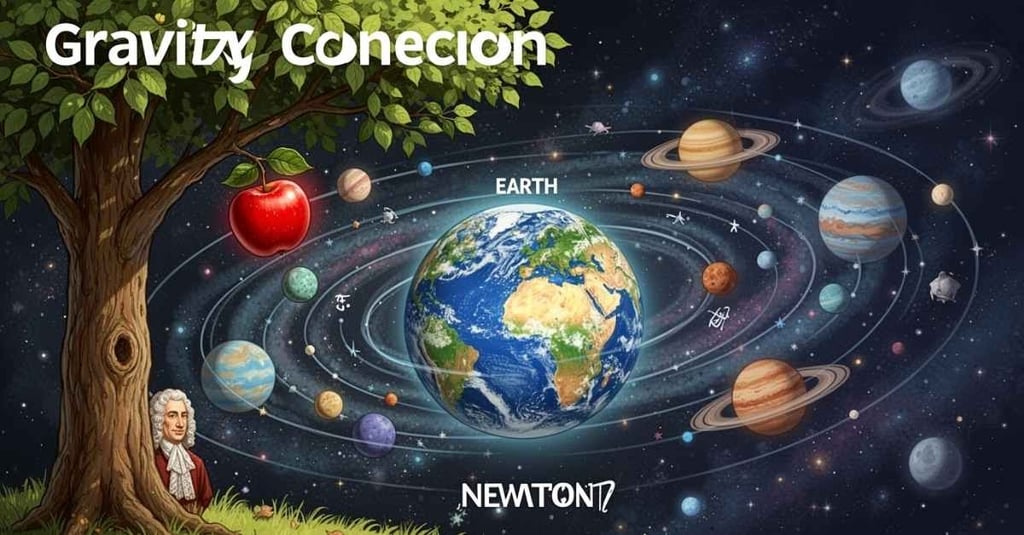
What is Gravity?
Gravity is a fundamental force that plays a crucial role in the universe, governing the motion of celestial bodies, determining the structure of galaxies, and influencing life on Earth. At its core, gravity is the attractive force that pulls two bodies toward each other. This force is dictated by the masses of the objects involved and the distance separating them. Isaac Newton's law of universal gravitation, formulated in the 17th century, posits that every particle in the universe attracts every other particle with a force that is directly proportional to the product of their masses and inversely proportional to the square of the distance between their centers.
Not only is gravity significant in the realm of physics, but it also manifests its effects in everyday life. It is responsible for keeping us anchored to the Earth, allowing us to walk, run, and engage in various activities without drifting into space. Additionally, gravity governs the motion of planets, moons, and stars, ensuring that celestial objects follow predictable paths. For example, the gravitational force exerted by the Earth causes the Moon to orbit around it, while the Sun's immense gravitational pull keeps the entire solar system in orbit.
Moreover, gravity influences a multitude of phenomena, such as ocean tides, which are caused by the gravitational pull of the Moon and the Sun on Earth's waters. It also plays a vital role in determining how objects interact within various gravitational fields, whether they are falling apples or orbiting satellites. Understanding gravity is essential not only for comprehending the laws of physics but also for exploring concepts such as black holes, the expansion of the universe, and even the very existence of life itself. Thus, gravity can be seen as both an everyday force that provides the foundation for life and an intricate component of the universe's grand design.
Newton's Law of Gravitation: The Foundation of Gravity
Isaac Newton's law of gravitation, formulated in the late 17th century, remains a pivotal discovery in the field of classical physics. This groundbreaking principle emerged during a period of intellectual fervor, which witnessed significant advancements in science, often referred to as the Scientific Revolution. Newton's insights were profoundly influenced by the work of his predecessors, including Galileo Galilei and Johannes Kepler, who laid essential groundwork regarding the nature of motion and celestial bodies.
The law of gravitation asserts that every point mass attracts every other point mass with a force that is directly proportional to the product of their masses and inversely proportional to the square of the distance between their centers. This relationship can be succinctly expressed through the formula: F = G(m1m2)/r², where F represents the gravitational force, G is the gravitational constant, m1 and m2 are the masses involved, and r denotes the distance separating their centers. Through this equation, Newton not only described how gravity operates between two objects but also provided a comprehensive model that could predict celestial movements.
Historically, this law marked a monumental shift in understanding the natural world. Prior to Newton, many traditional views attributed astronomical phenomena to divine intervention or mystical forces. The clarity and mathematical precision of Newton's law dispelled these notions, enabling a more rational comprehension of the universe. His principles explained not only the motion of falling objects on Earth but also the orbits of planets around the sun, unifying terrestrial and celestial mechanics under a single cohesive framework.
Ultimately, Newton's law of gravitation laid the foundation for modern physics and our current understanding of gravity. It has influenced countless scientific pursuits and remains a crucial reference point for both theoretical and applied physics, demonstrating how one fundamental principle can elucidate the intricate workings of our universe.
The Gravity Formula: Understanding the Math Behind the Force
Gravity, a fundamental force of nature, can be quantified using the universal law of gravitation encapsulated in the formula F = G (m1 m2) / r². Here, F represents the gravitational force between two objects, which is directly proportional to the product of their masses and inversely proportional to the square of the distance between them. This equation is pivotal in understanding how gravity operates within our universe.
The variable G, known as the gravitational constant, has a value of approximately 6.674×10⁻¹¹ N(m/kg)², which allows us to compare gravitational forces across different scales. It essentially acts as a proportionality factor ensuring that the units balance out in the equation. On the left side, F measures the gravitational force, and on the right side, m1 and m2 denote the masses of the two objects being considered.
Mass is a measure of the amount of matter an object contains; hence, the greater the masses involved, the stronger the gravitational attraction. The distance r is the separation between the centers of both masses, and as this distance increases, the gravitational force diminishes. This inverse square relationship means that even a small increase in distance can lead to a significant reduction in gravitational pull, highlighting the sensitivity of gravitational interactions.
Understanding this formula provides insight into the mechanics of celestial bodies, from planets orbiting the sun to objects falling to Earth. By mastering these variables and their relationships, we can appreciate the elegance of gravitational force as a key component of the cosmos.
Examples of Gravitational Force in Everyday Life
Gravity is an omnipresent force that governs many aspects of our daily existence, often going unnoticed until we actively observe its effects. One of the most straightforward examples is the act of dropping an object. When you release a ball or a book, the force of gravity pulls it straight down toward the Earth. This downward acceleration can be measured; objects fall at an approximate rate of 9.8 meters per second squared, a constant that reflects the gravitational pull of our planet. Such observable phenomena showcase how gravity influences simple actions we take every day.
Another familiar instance of gravitational force is the phenomenon of weight. When we weigh ourselves on a scale, the value we see is directly related to the gravitational force acting upon us. This force is not constant; it varies slightly depending on geographical location due to the Earth's shape and rotational speed. For example, someone weighing 70 kilograms in Kansas would weigh slightly less if they were at the equator. This variance demonstrates how gravity operates differently due to Earth’s mass distribution.
Additionally, gravity plays an essential role in the natural world, affecting large-scale structures such as rivers and mountains. Water flows downward in rivers due to gravity's persistent pull, shaping landscapes over centuries. The mountains we see today have been formed through processes influenced by gravity, including erosion and sediment deposition. Gravity is also the reason why celestial bodies like planets and stars maintain their orbits, as they are bound to one another through gravitational attraction. These instances reflect the significance of gravity not only in our everyday actions but also in the grand design of the universe.
The Importance of Gravity in Space Science
Gravity is a fundamental force that governs the structure and dynamics of the cosmos. It is the invisible binding agent that plays a significant role in the behavior and movement of celestial bodies, influencing the orbits of planets, stars, and entire galaxies. The effect of gravity is not only observable in the solar system but extends throughout the universe, shaping the very formations of celestial objects.
In the context of space science, understanding gravity is crucial for several reasons. For instance, the orbits of planets around the sun are determined by gravitational forces. This gravitational pull ensures that planets maintain a stable path during their revolution. Similarly, stars and galaxies are influenced by their own gravitational fields, which dictate their formations, densities, and interactions with neighboring celestial bodies.
A striking example of gravity's power can be observed with black holes—regions in space where the force of gravity is so strong that not even light can escape. The study of black holes provides vital insights into the laws of physics and challenges our understanding of time and space. Moreover, phenomena such as gravitational waves—ripples in space-time caused by massive events like black hole collisions—further illustrate gravity's complexity and importance in contemporary astrophysical research.
Additionally, gravity greatly influences spacecraft navigation and exploration. The trajectory of missions to distant planets and moons must account for gravitational influences from various bodies, including Earth, to ensure successful rendezvous. Advanced calculations regarding gravitational assists—using the gravitational pull of planets to gain speed—are integral to mission planning. This necessity underscores gravity's vital role not only in celestial mechanics but also in practical applications of space exploration, ultimately improving our understanding of the universe.
Simple Mathematical Examples of Gravity
Understanding gravity can be simplified through a few basic mathematical examples that illustrate its principles in a relatable manner. The gravitational force between two objects can be calculated using Newton's law of universal gravitation, which states that the force of attraction (F) between two masses (m1 and m2) is proportional to the product of their masses and inversely proportional to the square of the distance (r) between their centers. The formula is given by:
F = G * (m1 * m2) / r2
Where G is the gravitational constant, approximately equal to 6.674×10⁻¹¹ N(m/kg)2. For instance, let’s consider two objects with masses of 70 kg (for a person) and 5.97 x 1024 kg (the Earth) that are separated by a distance of 6.371 x 10⁶ m (the Earth's radius). Plugging these values into the formula gives:
F = (6.674×10-11) * (70 * 5.97 x 1024) / (6.371 x 10⁶)2.This results in a gravitational force of approximately 686 N, which is the weight of the person due to gravity.
Another practical calculation relates to finding the weight of an object on different planets. The weight of an object is calculated as:
Weight = mass * gravitational acceleration (g)
On Earth, g = 9.81 m/s2. If an object has a mass of 10 kg, its weight on Earth would be:
Weight = 10 kg * 9.81 m/s2 = 98.1 N.
However, on Mars, where g is approximately 3.71 m/s2, the weight would be:
Weight = 10 kg * 3.71 m/s2 = 37.1 N.
These simple calculations not only demonstrate the effects of gravity but also illustrate how the weights of objects change depending on their location in the universe, providing an understanding of gravity's pervasive influence in our lives.
FAQs About Gravity: Common Questions Addressed
Gravity is a fundamental force that plays a crucial role in the universe, yet many people have questions regarding its nature and effects. One of the most commonly asked questions is, "Why do objects fall down?" The answer lies in the gravitational pull exerted by massive bodies, such as the Earth. This pull attracts objects towards the center of the planet. The force of gravity acts on all objects, pulling them toward the Earth at an acceleration of approximately 9.81 meters per second square. This phenomenon explains why when an object is dropped, it accelerates towards the ground until it reaches the surface.
Another frequent inquiry concerns the historical understanding of gravity: "Who discovered gravity?" Although the concept of gravity has existed for centuries, Sir Isaac Newton is credited with formulating the laws of motion and universal gravitation in the late 17th century. In his groundbreaking work, "Philosophiæ Naturalis Principia Mathematica," Newton described gravity as an attractive force between two mass-laden bodies. His work laid the foundation for classical mechanics and significantly advanced human understanding of the forces that govern celestial movements.
A common misconception about gravity is that it only affects large objects, like planets and stars. However, gravity impacts all masses, regardless of size. For instance, even small objects like apples or marbles experience gravitational attraction. This principle highlights that gravity is a universal force acting on all matter, contributing to everything from the falling of raindrops to the motion of planets in our solar system.
Understanding gravity is pivotal not only for scientific exploration but also for appreciating the dynamics of our universe. By clarifying these common questions, we hope to enlighten readers and foster a greater comprehension of this essential force.
Address:
264/5, Kamal Soroni Road, Mirpur, Dhaka-1216
Contact
Your Quaries on pest control askings
pestexterminatorbd@gmail.com
+8801642008383 +8801988300003, 01723057746
© 2025. All rights reserved. to Urban Pest Control Pvt. Ltd. this site is powered by Our Own IT Team